

In our series on Selecting a Part Feeder, we’ve examined how to automate part handling to achieve configurable, high-volume, and dimensional feeding of parts through flexible, bowl, and 3D bin feeders, respectively.
But when a part fits the niche profile of a uniformly flat or stackable shape, integrators often turn to magazine feeders.
Magazine feeders have long been adapted by many diverse industries and manufacturing lines, for example:
The differences between stack and slot magazine feeders are significant. Let’s identify some of the key factors that determine which magazine feeding type is best suited to certain types of parts and requirements.
In general, magazine feeding refers to two different methods of presenting a set of same-shaped parts for transfer into the next stage of a manufacturing process. Depending on suitable part characteristics, the type of magazine feeder is determined by its part loading method.
Stack magazines are loaded with same-shaped, durable parts that stack well, enabling burst part feeding from a stack of prepared parts.
Manufacturing lines throughout many different industries employ the simplicity of stack magazines to gravity feed boards and flat parts like metal or corrugated sheets into a production line.
A) Stack Magazine – Bulk parts are loaded into stacks manually or automatically from another stage like a gantry or robot
B) Feed Mechanism – Individual parts are gravity fed from the stack and typically picked by a mechanical, pneumatic, or vacuum feeding mechanism, such as in the image above of top-loaded and bottom-fed boards
C) Part Transfer – Individual parts picked from the stack are moved into the next stage of manufacturing or conveyance
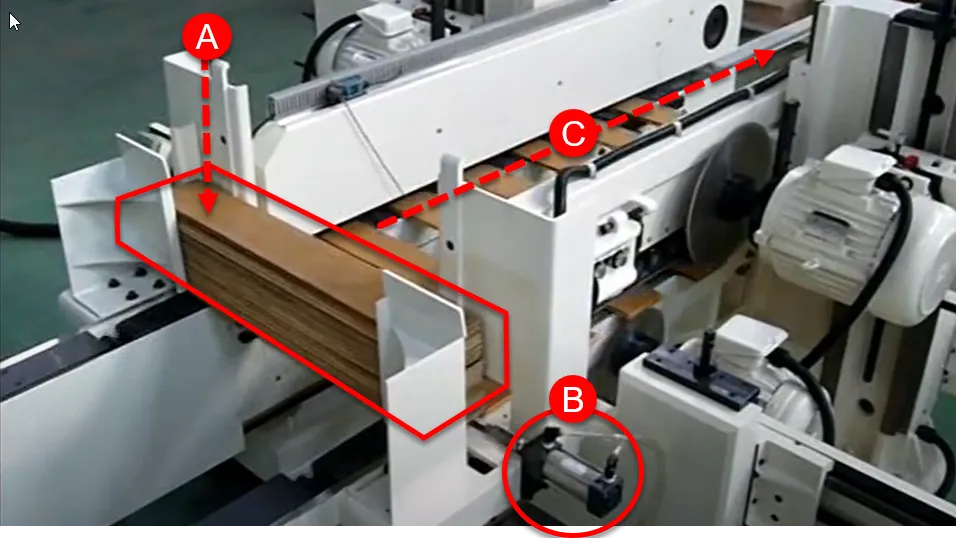
VIDEO CREDIT: PowerBase Auto Feed Magazine | YouTube
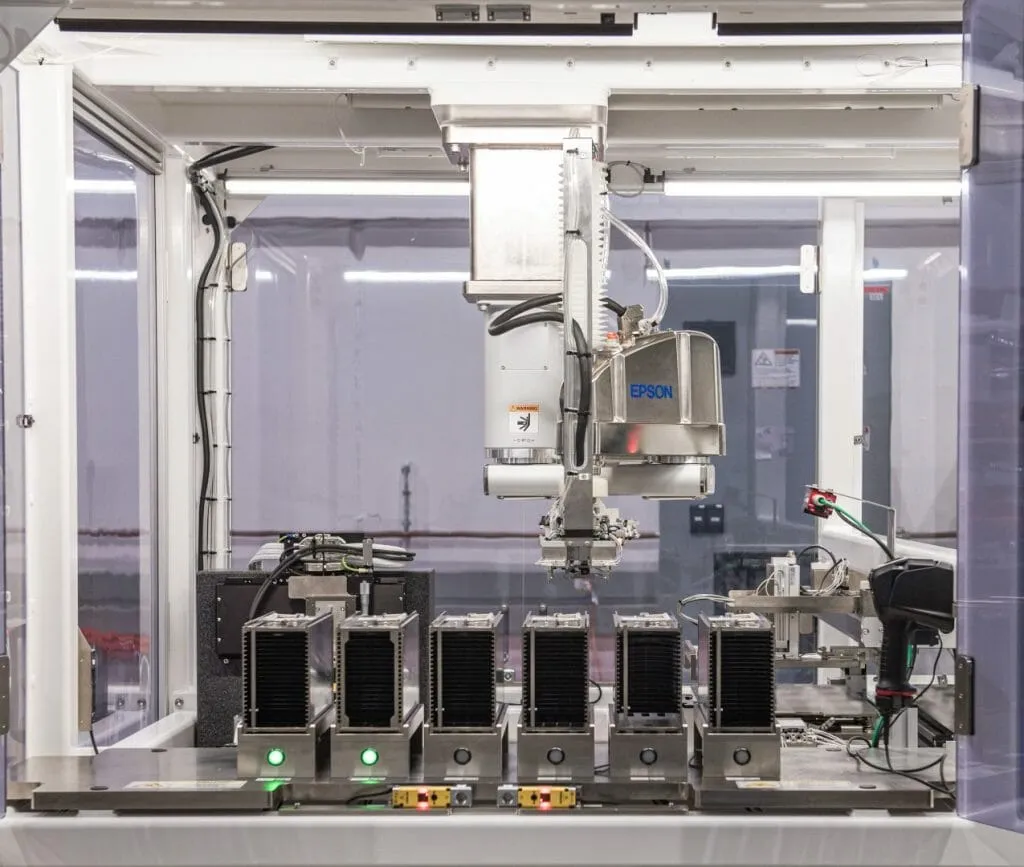
Slot magazines are loaded with same-shaped, flat parts that fit into individual slots retrievable by a PnP robot or feed mechanism, enabling burst part feeding from prepared magazine nests.
Electronics manufacturers turn to slot magazines for efficient feeding of flat printable circuit boards (PCBs) that are commonly used in consumer electronics and medical devices.
A) Slot Magazine – Preloaded magazine nests of parts that are positioned within individual slots are presented to a feeding mechanism or PnP robot
B) Feed Mechanism – Individual parts are retrieved from each slot, one at a time, using a simple mechanism or a PnP robot tooled with a gripper, depending on the movement required to advance the part into the system
C) Part Transfer – Individual parts picked from the nest are moved into the next stage of manufacturing or conveyance
Explore: Each type of magazine feeder has different loading and feeding mechanics.
Part durability or fragility largely determines whether it can be stacked or slotted.
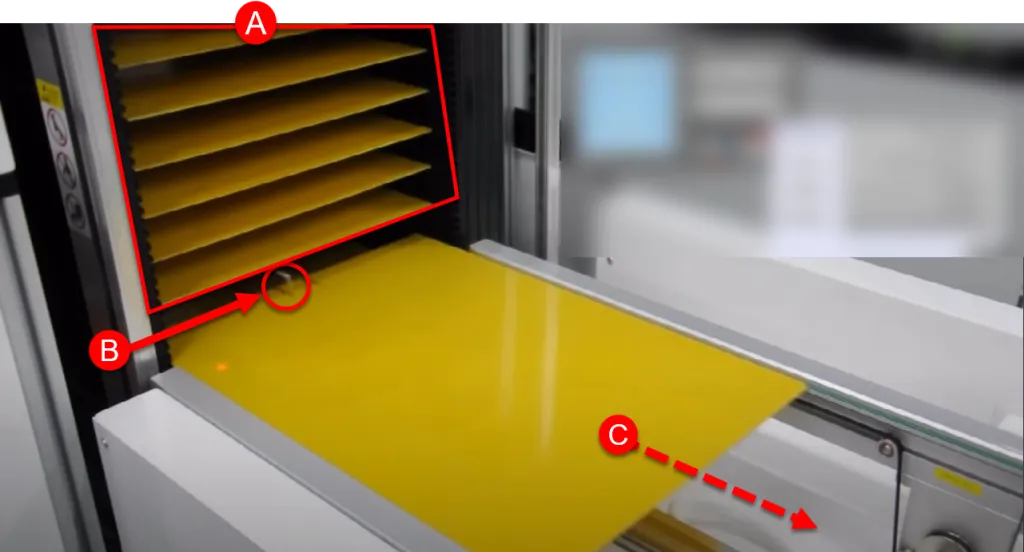
VIDEO CREDIT: 1ClickSMT PCB Handling Machine | YouTube
Stack magazines enable the simplest approach for transferring parts into an assembly line. However, parts that may be damaged by the stacking process are not suitable for stack magazine feeding.
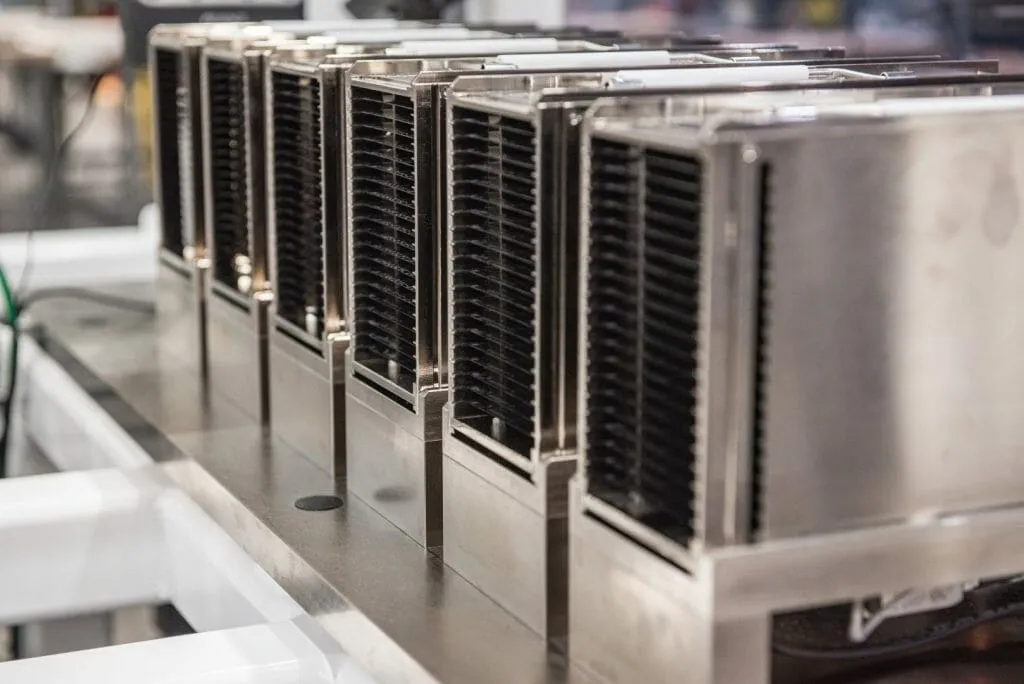
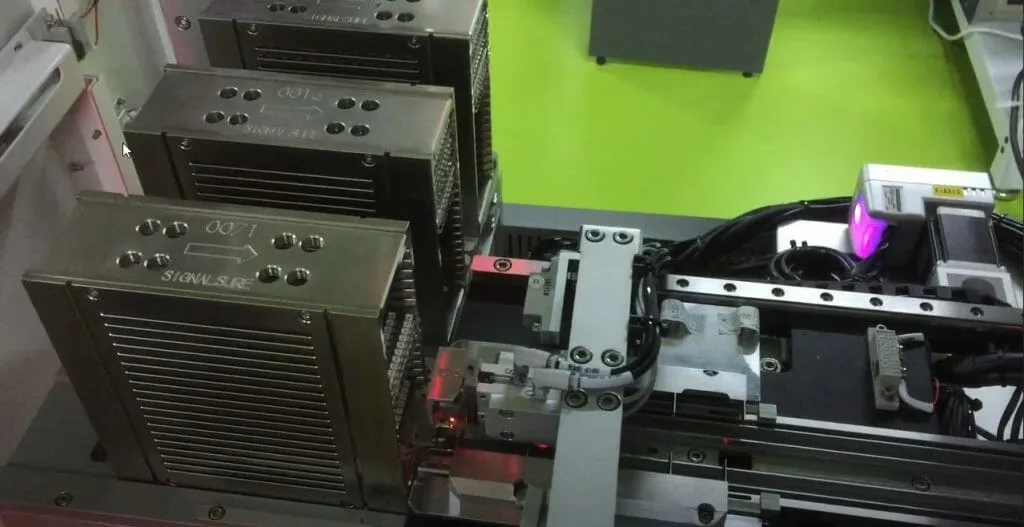
Slot magazines, by contrast, are designed for a more careful and precise transfer of parts into an assembly line, and so require a more complex implementation to configure PnP robots or mechanisms to relocate parts into each slot in the nest. Slot magazine feeding has the added benefit of enabling tracking of individual parts, slots, and nests for system logging and quality traceability.


The overriding factors for parts that are well-suited for stack magazine feeding are material durability (plastics, laminates, woods, or metals) and part stability when stacked.
Slot magazine feeding is ideal for parts that need to be handled more carefully and precisely to avoid damage, such as with circuit boards or polished material surfaces that might be marred by other handling processes.
Depending on the requirements of your manufacturing process, there are ways to upgrade each type of magazine feeder with components that improve the loading, staging, identification, and release of parts into your assembly system. Enhancements to a magazine feeding system reduce machine idle time to improve efficiency and rate of production.
Though stack magazine feeding is a simpler method of presenting parts, the following components may add value to your overall process:
Slot magazine feeding operates with higher complexity to enable the picking and placing of individual parts from the nest, but can also be improved with some additional components, such as:
Although stack magazine feeders are less complex than other part handling systems, preparing in advance for implementation is helpful to ensure the successful configuration of the magazine and feed mechanism.
Part Supply Objective
Ensure the process to load and replenish bulk parts is optimal for the required speed of processing.
Test Considerations
Where and how will bulk parts be stored and identified?
How should parts be loaded into and removed from the system? (i.e. for LIFO, parts are loaded in from the top and removed from the top; for FIFO, parts are loaded from the top and removed from the bottom)
How will parts be correctly oriented into the magazine? Does the design of the part need to include a profile to identify the correct orientation? (e.g. a marking is added to the plane of the part to identify which side is the top or bottom, or added to perimeter to identify which edge is the front or back of the part)
As parts run low in the stack, how will parts be replenished?
Are specific tools or equipment needed to optimize the staging and loading of parts?
Are parts loading smoothing into the magazine or are mechanical adjustments needed to enable smoother stacking?
Part Feeding Mechanism Objective
Ensure individual parts are fed accurately from the stack magazine.
Test Considerations
Are parts consistently picked and advanced into the system without errors?
For bottom-feeding magazines, does the weight of stacked parts impede the feeding mechanism? Does the number of parts in the stack need to be reduced to reduce the overall weight of stacked parts and enable individual parts to be fed from the bottom of the stack?
Does the part feeding mechanism need to be adjusted for greater speed or accuracy to fine-tune mechanical, pneumatic, or vacuum performance?
Does the feed size need to be adjusted for the part size?
With a higher degree of complication and more components to configure, a proper test plan is critical to ensure successful implementation of a slot magazine feeding system into your manufacturing line.
Part Supply Objective
Ensure the process to prepare part nests is optimal for the required speed of processing.
Test Considerations
Where and how will bulk parts be stored and identified?
How should parts be loaded into and removed from the system? (i.e. to prevent the transfer of debris as parts are inserted into magazine slots, LIFO is the preferred method enabling parts to be loaded from the top down and removed from the bottom up)
Where and how will nests be stored and identified?
How will parts be prepared, correctly oriented, and slotted into the magazine? Does the design of the part need to include a profile to identify the correct orientation? (e.g. a corner notch to identify which edge is the front or back of the part)
As parts run low in the stack, how will parts be replenished?
Are specific tools or equipment needed to optimize the staging and loading of parts?
Ensure individual parts are accurately picked from the slot magazine nest.
Test Considerations
Are parts consistently picked and placed by the feed mechanism or PnP robot without errors?
Does the feeding mechanism or robot need to be adjusted for greater speed or accuracy to fine-tune its performance?
Does the gripper need to be adjusted for the part size?
Magazine Nests Objective
Ensure the customization of magazine nests enables optimal placement and stability of slotted parts.
Test Considerations
Are the dimensions of magazine nests enabling smooth, accurate, and stable loading of individual parts?
Are slots either too constricted (parts cannot be easily loaded) or too loose (parts are slipping out of slots when or after loading)?
What positional markings are needed to enable accurate part orientation in individual slots?
What positional markings are needed to enable accurate magazine orientation when nested for part presentation?
Are specific tools or equipment needed to optimize the staging and loading of magazine nests?
How many spare magazines are required to support the loading, offloading, cleaning, and other processes that enable the line to run? (e.g. spare magazines are often required for offline transportation of parts in addition to magazines that are used to present nested parts into the line)
Vision System Objective
Ensure vision detection of part presence and vision scanning of identification numbers or codes.
Test Considerations
Are vision sensors accurately and consistently detecting part presence?
Are vision scanners accurately and consistently identifying barcoded numbers or codes?
What adjustments are needed to improve the detection accuracy and speed of vision sensors or scanners?
Overall, the choice between stack and slot magazine feeders depends on the specific part characteristics, required capacity, orientation needs, and operational flexibility required by your application. Each magazine feeder comes with its own distinct advantages and suitability for your manufacturing environment.
For help selecting the right part handling solution, connect with our engineers to share your unique application requirements.