
For years, Industry 4.0 sounded more like a vision statement than an engineering roadmap. But in the past five years, technologies and standards have finally caught up. Real interoperability between operational technology (OT) and information technology (IT) systems is no longer theoretical; it’s what makes connected manufacturing possible today.
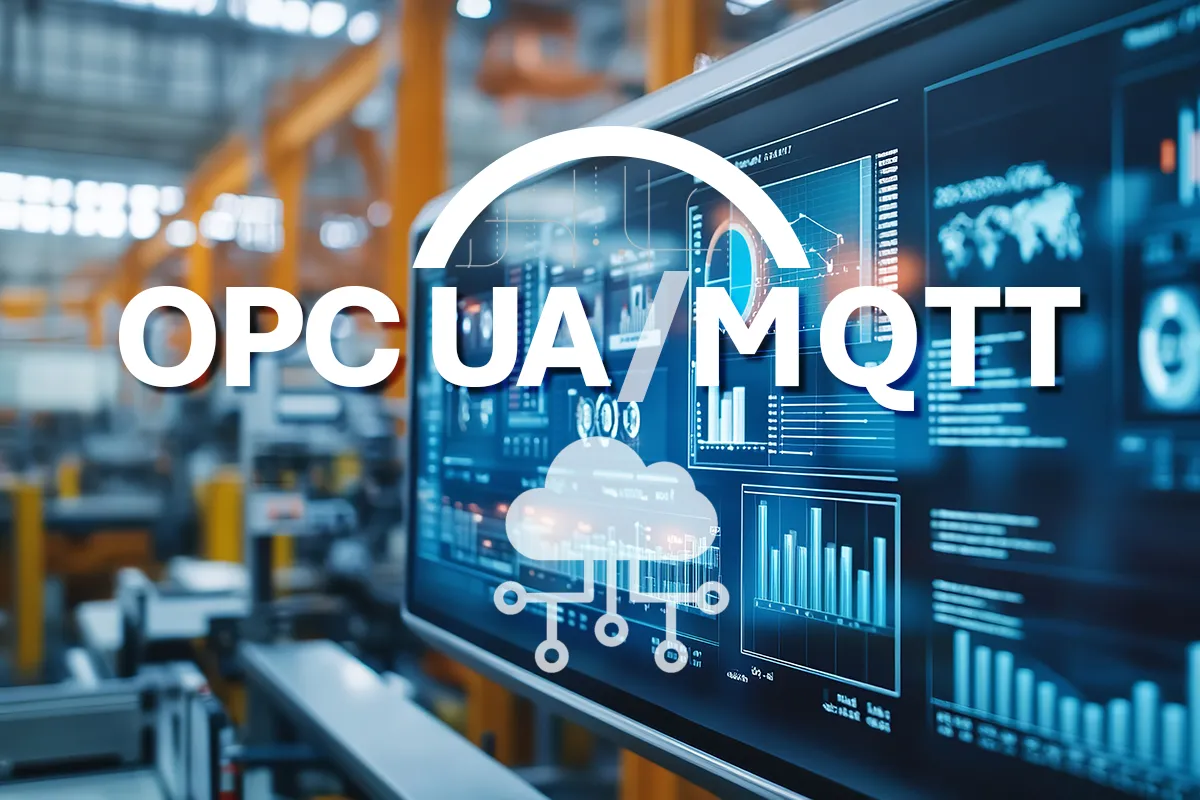
Over the past several years, OPC UA and MQTT have been among the most discussed data-connectivity topics in automation forums, conferences, and trade journals. The “which protocol, or both?” question is a common point of discussion in digital-transformation and IIoT circles. Once viewed as competing protocols, they’re increasingly complementary and two sides of the same industrial-data coin.
At Andrews Cooper (AC), we see this hybrid model gaining momentum across automation and robotics. The challenge is no longer which protocol to use; it’s how to integrate both seamlessly.
Inside most factories, OPC UA keeps machines and control systems speaking a common, structured language, rich with context and meaning. But when that data needs to travel beyond the plant to dashboards, cloud systems, or analytics, MQTT takes over. It’s fast, efficient, and built for sharing information across networks.
Together, they form the backbone of modern connected manufacturing: OPC UA organizes the data, MQTT moves it. And when paired with Sparkplug B, an open standard that adds structure and consistency to MQTT messages. The two can exchange industrial data reliably from the factory floor to the cloud.
OPC UA (Open Platform Communications Unified Architecture) is the industrial-automation standard for structured, secure, and contextualized data exchange. It provides hierarchical data models with metadata, units, and semantics—ideal for deterministic, high-integrity communication inside plants.
MQTT (Message Queuing Telemetry Transport) is a lightweight publish/subscribe protocol designed for reliable communication over low-bandwidth or unreliable networks. It’s perfect for moving industrial data efficiently between edge devices and cloud systems.
Sparkplug B is an open standard maintained by the Eclipse Foundation that defines how MQTT messages are structured for industrial use. It adds context, state awareness, and standard naming conventions to MQTT payloads—making data more consistent and interoperable across different systems and vendors.
OPC UA (Open Platform Communications Unified Architecture) is the industrial-automation standard for structured, secure, and contextualized data exchange. It provides hierarchical data models with metadata, units, and semantics—ideal for deterministic, high-integrity communication inside plants.
MQTT (Message Queuing Telemetry Transport) is a lightweight publish/subscribe protocol designed for reliable communication over low-bandwidth or unreliable networks. It’s perfect for moving industrial data efficiently between edge devices and cloud systems.
Sparkplug B is an open standard maintained by the Eclipse Foundation that defines how MQTT messages are structured for industrial use. It adds context, state awareness, and standard naming conventions to MQTT payloads—making data more consistent and interoperable across different systems and vendors.
The push to connect factory systems with enterprise networks began as a practical engineering challenge to get reliable, structured data out of machines and into systems that could use it.
Today, the challenge has evolved into a guiding principle for connected automation: bridging the reliability of OT with the scalability of IT.
By using each protocol where it excels and unifying them through intentional design, automation engineers can now build systems that keep process control predictable and reliable while making data securely available for analytics and compliance. Across industries, the most effective architectures now rely on both OPC UA and MQTT working in tandem across different layers of the enterprise.
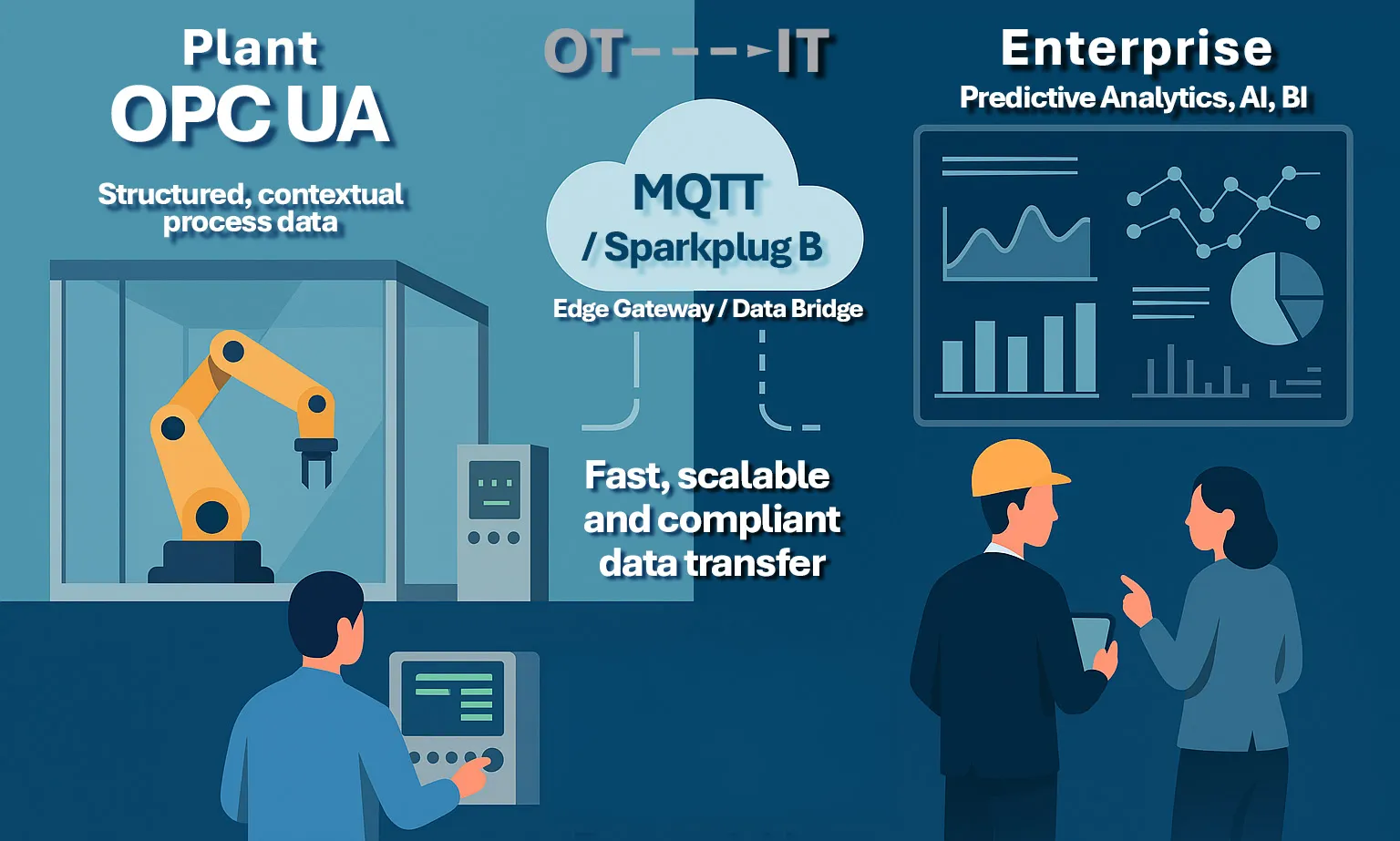
This hybrid approach preserves data richness at the edge while unlocking agility and scale in the cloud, delivering a best-of-both-worlds model that mirrors how AC engineers bridge HardTech and digital transformation.
So, what does this data flow look like for a medical device workcell assembling and laser-etching surgical instruments? Every serial number, inspection result, and operator signature contributes to the device’s compliance record. Each event, from laser parameters to inspection pass/fail outcomes, must be timestamped, attributed, and preserved for audit under 21 CFR Part 11.
OPC UA standardizes that data from robots, lasers, and vision systems, capturing context like lot code, process parameters, and equipment ID in a structured, secure format. MQTT with Sparkplug B then transports that structured information to MES or cloud analytics systems, maintaining its integrity while enabling real-time visibility across shifts and production sites.
Together, they turn required traceability data into actionable insight—linking quality, compliance, and performance so teams can spot trends or process drift before they become regulatory risks.
That’s the integration challenge we solve every day. Our teams design the data models and gateways that let structured OPC UA data from automation systems flow seamlessly through MQTT, ensuring the right data reaches the right system securely, efficiently, and with all the identifiers and metadata intact for traceability and compliance.
For automation engineers, the value of OPC UA and MQTT isn’t just in how they work—it’s what they enable when systems are designed for seamless data flow, scalability, and long-term adaptability.
Today, the challenge has evolved into a guiding principle for connected automation: bridging the reliability of operational technology (OT) with the scalability of information technology (IT).
Across automation, the hybrid OPC UA + MQTT model is gaining traction not just in manufacturing but also in robotics, energy, and MedTech, and anywhere reliability meets connectivity.
At Andrews Cooper, we know integration success isn’t about choosing one protocol over another. It’s about designing the data model, hierarchy, and flow with purpose.
Our engineers develop purpose-built robotics and automated systems that think beyond the machine data:
The evolution of OPC UA and MQTT reflects the convergence of data, delivering a more connected, intelligent, and adaptive automation ecosystem.
Engineering the Impossible in HardTech means uniting physical engineering with the digital backbone of data integrity, architecture, and intelligence.
As these connected data layers mature, the next evolution is already underway with machines that learn from that data in real time. Check out our last blog where I explore how these architectures are powering adaptive robotics and Physical AI, the foundation for truly intelligent automation.
As OPC UA and MQTT bring data to life across connected factories, the next frontier is how we visualize and interact with that data.
That’s where OpenUSD is changing the game by creating a shared digital environment where robotics, AI, and automation can be simulated, tested, and perfected before deployment.
COMING SOON: Next, I’ll dive into how digital twins are becoming the bridge between connected systems and intelligent, self-improving machines.
Explore insights into Physical AI—the emerging intersection of intelligence, embodiment, and engineering progress.
Have an "impossible" problem to solve? Connect with us to speak with an engineer.