
Robotics development is the process of designing, engineering, and integrating robotic systems that can perform specific tasks reliably in real-world environments. It combines mechanical engineering, electronics, embedded software, sensing, actuation, and control systems to transform an initial concept into a functional robotic product.
As robotics applications expand across manufacturing, healthcare, logistics, and other industries, developing a successful robotic product requires more than assembling hardware and writing software. Every component must work together as part of a coordinated system, balancing performance, reliability, safety, and manufacturability.
For companies developing custom robotic products, the challenge is connecting these engineering disciplines from the earliest design decisions through prototyping, validation, and production. This guide explores the robotics development process, the engineering disciplines involved, and the considerations that help turn robotic concepts into production-ready products.
Robotics development involves the engineering activities required to create robotic systems, from initial requirements and system architecture to hardware development, software integration, testing, and manufacturing preparation.
Unlike conventional product development, robotics projects involve several tightly connected engineering disciplines. Mechanical structures, electrical systems, sensors, actuators, embedded electronics, and control software must operate together to achieve the intended functionality.
A change to one subsystem can affect the performance of the entire robot. For example, selecting a different motor can influence power consumption, thermal management, mechanical dimensions, control requirements, and overall system performance.
A typical robotics development project may involve:
The objective is not simply to build a robot that works under controlled conditions. It is to develop a complete product that performs consistently, can be maintained, and can eventually be manufactured at the required scale.
Successful robotics development requires a structured engineering process. Although the exact workflow depends on the application, most projects progress through several interconnected stages.
Every robotics project begins with understanding the problem the product needs to solve. Before selecting components or developing mechanical designs, engineers must establish the robot's intended functionality, operating environment, performance requirements, and technical constraints.
Important considerations include:
These requirements establish the engineering foundation for the project. A feasibility assessment can then identify technical uncertainties, evaluate potential technologies, and determine whether the proposed system can achieve its intended performance within the available constraints.
Addressing these questions early helps reduce technical risk before significant resources are committed to detailed engineering.
Once the requirements are established, the next step is defining the system architecture. Robotics system architecture determines how the different mechanical, electrical, and software components interact to achieve the robot's functionality.
This stage involves establishing subsystem boundaries, defining interfaces, selecting suitable technologies, and evaluating how individual components will operate together.
Key engineering activities include:
Mechanical and electrical decisions must be considered together. For example, motor selection influences mechanical packaging, power requirements, thermal performance, and control system design. Similarly, sensor placement affects mechanical geometry, wiring, processing requirements, and the accuracy of the robot's perception system.
An integrated architecture helps ensure that individual engineering decisions support the overall product requirements rather than creating problems during later integration.
With the system architecture established, engineers can begin developing the individual hardware and software components. Robotics development typically involves parallel engineering workstreams that must remain coordinated throughout the project.
Mechanical engineering focuses on the physical structure and movement of the robotic system. This can include designing frames, enclosures, linkages, joints, transmissions, end effectors, and other mechanisms.
Engineers must consider structural strength, weight, material selection, dimensional tolerances, motion requirements, and environmental conditions. Electromechanical design connects these mechanical elements with motors, actuators, sensors, and electronic control hardware.
The electronic architecture provides the interfaces, processing capabilities, and power systems required to operate the robot.
Depending on the application, development may involve:
Embedded software is particularly important because it connects the robot's physical components with its control and decision-making functions.
Robotics software coordinates the behavior of the system by processing sensor information, executing control algorithms, and generating commands for actuators. Depending on the application, software development may include motion control, motor control, sensor fusion, computer vision, navigation, and autonomous decision-making.
The Robot Operating System (ROS) can also provide middleware and development tools for applications requiring communication between multiple robotic software components. The specific software architecture should reflect the product's functional requirements, computing constraints, and operating environment.
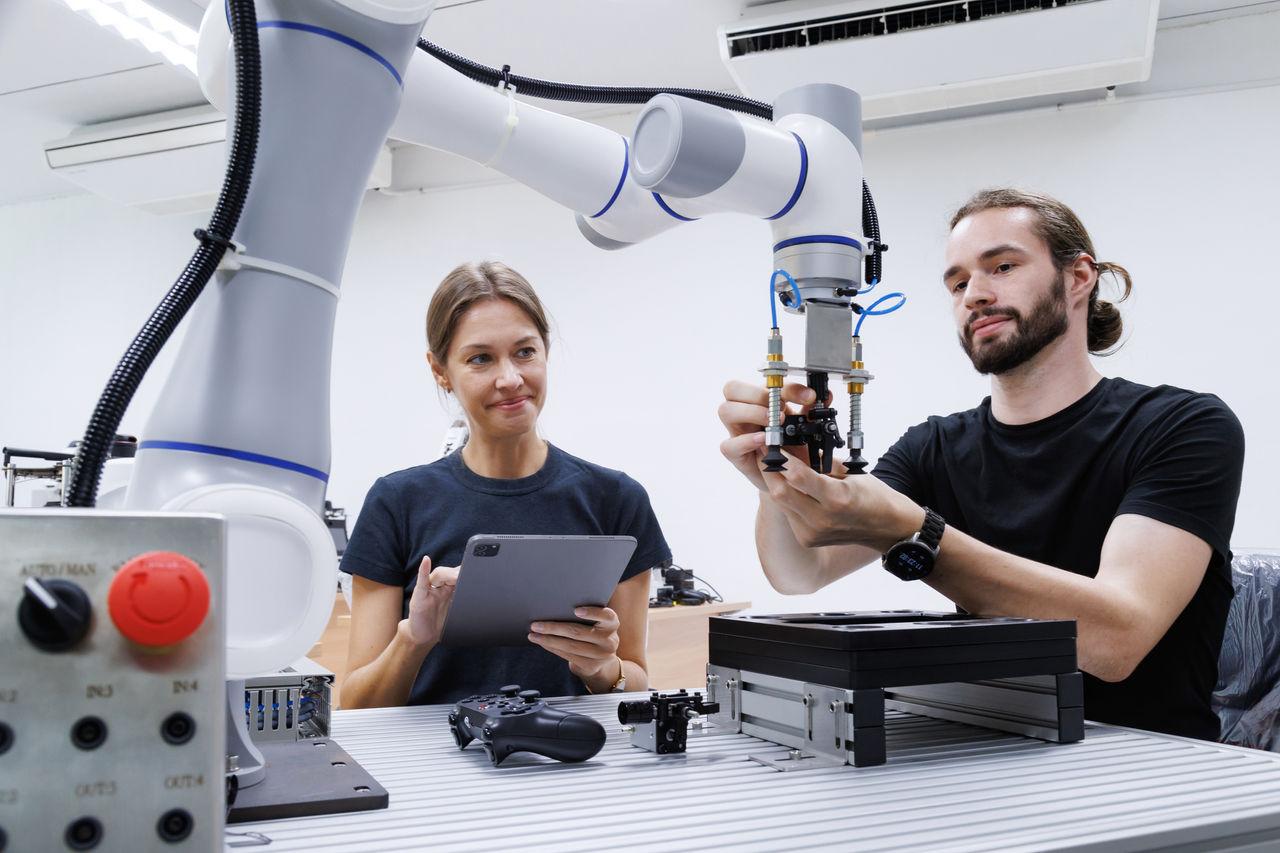
Prototyping is a critical stage of robotics development because it allows engineers to evaluate design decisions using physical hardware. While simulations and individual component tests can help identify potential problems, real-world prototypes reveal issues that may not be apparent during theoretical design.
These can include mechanical interference, unexpected vibration, sensor inaccuracies, electrical noise, thermal limitations, and inconsistent actuator performance.
A robotics prototype typically evolves through several levels of development:
During integration, engineers verify that mechanical assemblies, electronics, sensors, actuators, firmware, and control software operate together as intended. This process is iterative. Testing often identifies improvements that require adjustments to the original design or system architecture.
Early integration helps expose interface problems before they become expensive to resolve.
A functional prototype is not necessarily a reliable robotic product. Robotics validation must establish whether the system consistently meets its requirements under realistic operating conditions. Testing should be based on measurable performance criteria established during the requirements stage.
Depending on the application, this may involve:
Testing should also evaluate how the robot behaves outside ideal operating conditions.
For example, changes in lighting, surface conditions, payload, temperature, or sensor inputs may affect system performance. Engineers use test results to identify performance limitations, refine control algorithms, improve mechanical components, and optimize the integrated system.
Simulation can support this process by allowing engineers to evaluate selected scenarios before testing on physical hardware. However, simulation should complement rather than replace validation using representative physical systems. The objective is to establish a repeatable level of performance that supports the intended application.
One of the most important transitions in robotics development is moving from a working prototype to a product that can be manufactured consistently.
A prototype may rely on custom-fabricated parts, development boards, temporary wiring, or manual adjustments. These solutions can be useful during early development but may not be appropriate for production. Design for Manufacturing (DFM) and Design for Assembly (DFA) help address these limitations.
During this stage, engineers evaluate:
Robotics products also require careful consideration of software and firmware configuration during manufacturing. Each manufactured unit must have the appropriate software version, calibration settings, and functional testing procedures.
A production-ready design should therefore account for the entire product lifecycle, not just initial functionality. By addressing manufacturability, assembly, and serviceability before production, engineering teams can reduce unnecessary complexity and support more consistent product quality.
Robotics projects involve technical challenges that emerge from the interaction between multiple engineering disciplines. Understanding these challenges early helps teams make better design decisions and avoid costly development delays.
Mechanical, electrical, and software systems are closely interconnected. A modification to one subsystem can create unexpected consequences elsewhere in the product. Successful robotics development requires coordinated engineering decisions, clearly defined interfaces, and continuous communication between disciplines.
Robotic systems often operate under strict weight, space, and energy constraints. Motors, actuators, processors, and sensors all contribute to overall power consumption and thermal requirements. Engineers must balance computational performance, mechanical capability, operating duration, and system efficiency.
Sensors provide the information robots need to understand their environment and monitor their own operation. However, sensor performance can be affected by noise, vibration, environmental conditions, calibration errors, and differences in sensor positioning. Careful sensor selection, integration, calibration, and validation are essential for reliable operation.
A successful demonstration does not automatically translate into a commercially viable product. Production introduces additional requirements involving component sourcing, assembly processes, manufacturing tolerances, quality control, and long-term serviceability.
These considerations should influence engineering decisions throughout the development process rather than being addressed only at the end.
Developing a robotic product requires expertise across multiple engineering disciplines. For companies without all the necessary capabilities in-house, working with an experienced robotics development partner can help accelerate development and reduce technical uncertainty.
When evaluating a robotics development company, consider the following factors:
Look for a partner capable of working across mechanical engineering, electronics, embedded software, and system integration. The ability to coordinate these disciplines is essential when developing complex robotic products.
A development partner should be able to build and test functional prototypes, identify technical risks, and refine designs based on measured performance.
Robotics development should be approached as an integrated engineering problem rather than a collection of independent hardware and software tasks.
A strong partner understands the transition from prototype development to production, including design for manufacturability, component selection, assembly, and testing.
Robotics projects frequently involve evolving requirements and technical uncertainties. Engineering teams should be able to adapt designs and development priorities as new information becomes available. The right partnership combines engineering expertise, practical problem-solving, and an understanding of what it takes to deliver a reliable physical product.
Robotics development requires the integration of mechanical engineering, electronics, embedded software, sensing, actuation, and control systems into a coordinated product architecture. From initial feasibility assessments and system design to prototyping, validation, and manufacturing preparation, every stage contributes to the performance and reliability of the final product.
The most successful robotics projects consider these requirements from the beginning. Rather than treating hardware, software, and manufacturing as separate activities, they approach development as a connected engineering process.
For companies building custom robotic products, this integrated approach helps reduce technical risk, improve system performance, and create a stronger foundation for production. At Andrews Cooper, robotics development brings together multidisciplinary engineering, prototyping, and system integration to create robotic products designed for real-world applications.