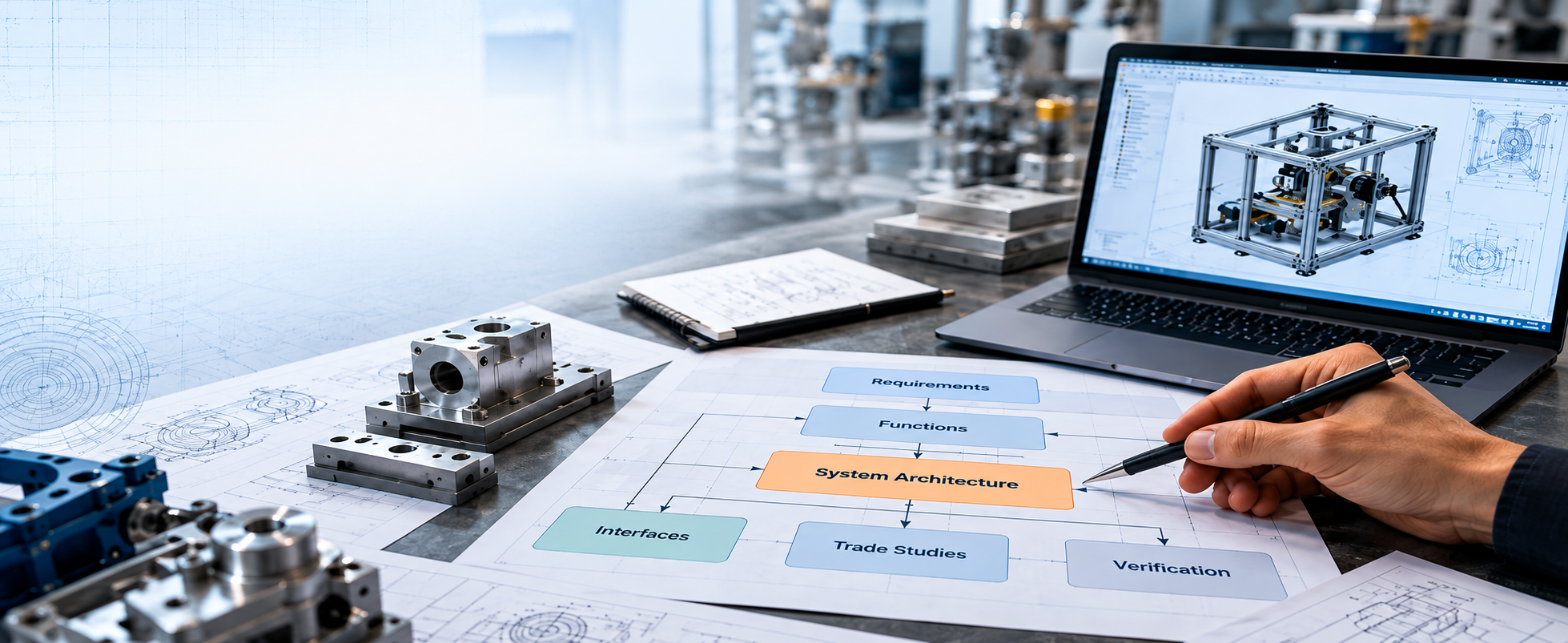

A practical engineering approach to translating requirements into system functions, architecture, interfaces, trade studies, and a design that can be verified and manufactured.
Defining a system architecture is not simply a matter of drawing boxes and connecting them with lines. The difficult part is deciding what those boxes should represent, where system boundaries should exist, which functions belong together, how interfaces should work, and which architectural approach best satisfies the requirements.
For complex engineering systems, those decisions often cross mechanical, electrical, embedded, controls, test, and manufacturing disciplines. Architecture development is therefore a technical decision-making process.
The objective is to establish enough structure early in development that the engineering team can make informed detailed design decisions without unnecessarily constraining the system.
System architecture should begin with the system need and the requirements that define success. Starting with components can create premature constraints.
For example, choosing a particular processor before understanding system-level computing, thermal, power, timing, and communication requirements can force the rest of the architecture to adapt around that decision. Instead, engineers should first establish what the system needs to accomplish and under what conditions it must operate.
Requirements should describe measurable outcomes and constraints wherever possible. For a robotic inspection system, that could include inspection accuracy, cycle time, environmental conditions, available space, operator interaction, communication requirements, and production constraints.
These requirements provide the basis for evaluating architectural alternatives.
Once the requirements are understood, the next step is to determine the functions the system must perform. Functional decomposition separates what the system must do from how the system will do it.
This distinction creates room to explore different architectural solutions. Consider an automated inspection system. At a high level, it may need to receive a part, position the part, acquire inspection data, process that data, determine an outcome, and communicate the result.
Those functions do not yet dictate whether the system will use a particular camera, motion platform, processor, PLC, or software framework. The architecture development process uses the functional model to explore how those responsibilities can be allocated to physical and logical system elements.
Functional decomposition should provide enough detail to support meaningful engineering decisions without creating an unnecessarily complicated model. The appropriate level depends on the system.
A simple product may require only a small number of functional blocks. A complex automated machine may require several layers of decomposition connecting high-level system functions to subsystem responsibilities. The important question is whether the decomposition helps the engineering team understand the system.
For example, an inspection platform might be decomposed into motion, sensing, illumination, computing, control, safety, and manufacturing-interface functions. Each function can then be examined in relation to requirements and interfaces.
The result is not yet a detailed design. It is a structured description of what the system must accomplish.
Once the functions are understood, engineers can explore how they should be allocated. A function may belong entirely to one subsystem or may require cooperation between several elements.
For example, precision positioning may depend simultaneously on mechanical stiffness, motor selection, encoder feedback, motion-control algorithms, and embedded processing. Allocating the function therefore requires more than selecting a component.
It requires understanding the interaction between the elements responsible for producing the required system behavior. This is where system architecture begins to become an engineering decision rather than a documentation exercise.
There is rarely only one possible architecture. Two architectures may both satisfy the primary functional requirements while producing very different consequences for complexity, cost, performance, reliability, manufacturing, or verification.
An architecture trade study provides a structured way to compare those alternatives. The criteria should come from the actual system requirements and engineering constraints. For example, a control architecture might compare centralized and distributed processing.
The purpose of the trade study is not to identify a universally superior architecture. The purpose is to determine which approach is appropriate for the requirements and constraints of the particular system.
A trade study becomes useful when it exposes consequences that might otherwise remain hidden. Suppose two architectures provide equivalent basic functionality.
One may reduce component count but create a difficult thermal problem. Another may increase hardware complexity but make testing and serviceability easier. A third may simplify the prototype while making production integration more difficult.
These differences should be visible before the architecture is committed. The engineering team can then make the decision deliberately rather than allowing the architecture to emerge accidentally from individual component choices.
Once system elements have been identified, their interfaces need to be defined. Interfaces describe the conditions under which two elements interact.
A mechanical interface can establish mounting geometry, alignment, stiffness, loads, and tolerances.
An electrical interface can establish voltage, current, grounding, power sequencing, and signal characteristics.
A software or data interface can establish protocols, data structures, timing, synchronization, and error handling.
For complex systems, interfaces often represent the highest-risk boundaries because they cross subsystem and disciplinary boundaries.
A mechanical engineer may define a mounting interface without realizing that the location creates an electrical routing problem. A controls engineer may define timing assumptions that the embedded implementation cannot satisfy. A manufacturing engineer may identify an assembly constraint that changes the preferred subsystem partitioning.
Architecture provides the common context for resolving these interactions.
Architecture should be developed with verification in mind. Every important requirement eventually needs a way to demonstrate that it has been satisfied. That means the engineering team should understand where a requirement is implemented and how its behavior can be observed or measured.
This relationship can be expressed simply:
Requirement → Architectural allocation → Design implementation → Verification method
For example, if a system has a positioning accuracy requirement, the architecture should establish which mechanical, sensing, control, and software elements contribute to that behavior. The verification strategy can then be developed around the complete system behavior rather than treating the requirement as a late-stage test activity.
This approach also helps identify requirements that are difficult or expensive to verify. If a proposed architecture makes verification unusually complicated, that may be a reason to reconsider the architecture itself.
A system architecture that works in a prototype environment may not work equally well in production. Prototype development often accepts manual assembly, custom adjustment, individual calibration, or specialized test procedures.
Production requires repeatability. Architectural decisions can affect how components are assembled, how systems are calibrated, where production testing occurs, how suppliers provide components, and how the finished system can be serviced.
For this reason, manufacturing should influence architecture before detailed design is fully committed. Design for manufacturing is not simply a final review activity.
Architecture should provide stability without becoming rigid. As engineering progresses, new information becomes available.
Prototype testing may reveal unexpected behavior. Component availability may change. Thermal analysis may expose a packaging problem. Manufacturing analysis may identify an assembly constraint. Verification may reveal that a requirement is difficult to demonstrate with the current design.
Those findings can require architectural changes and this is normal in complex engineering development. The objective is not to prevent architectural change.
The objective is to make architectural change deliberate, traceable, and increasingly less frequent as the design matures.
Architecture should be reconsidered when new information challenges a fundamental assumption.
For example, a change may be warranted when:
The important distinction is between healthy architectural iteration and uncontrolled design churn.
A mature engineering process uses evidence to determine when an architectural decision should remain stable and when it should be revisited.
Before detailed design proceeds too far, an architecture review should establish whether the proposed structure provides a credible path to the required system.
The review should examine the relationships between requirements, functions, system elements, interfaces, verification, and manufacturing.
Three questions provide a useful starting point:
Does the architecture satisfy the requirements?
The major requirements should be allocated to appropriate system functions and elements, with assumptions and unresolved questions identified.
Are the interfaces understood?
The engineering team should understand how the major elements interact and what each subsystem expects from the others.
Can the resulting system be designed, verified, manufactured, and evolved?
A technically functional architecture still needs to provide a practical path through detailed engineering, testing, production, and future change.
Once the architecture is sufficiently mature, detailed engineering can proceed with a clearer understanding of system responsibilities and interfaces. Mechanical engineers can develop mechanisms and structures within defined system boundaries.
Electrical engineers can develop power and signal architectures consistent with system requirements. Embedded engineers can define firmware and communication behavior. Controls engineers can develop algorithms around established sensing and actuation relationships.
Test engineers can develop verification methods against known requirements and interfaces. Manufacturing engineers can evaluate how the resulting design will transition into repeatable production. The architecture does not replace those disciplines.
It gives them a shared technical framework.
A useful architecture review does not need to produce dozens of documents. The objective is to establish that the important technical decisions are understood and supported by the available evidence.
The review should be able to explain how the system satisfies its requirements, how the major elements interact, and where important uncertainty remains. It should also make clear which decisions are established and which remain open for investigation.
This creates a much stronger foundation for detailed design than simply declaring an architecture complete because a system diagram has been produced.
System architecture is most valuable when it continues to inform engineering after the initial concept phase. It provides the structure for detailed design, integration, verification, manufacturing, and future changes. For complex products, that continuity matters.
A system may begin as an uncertain concept, become a functional prototype, transition into a validated product, and eventually become a production system. The architecture provides a technical reference throughout that progression.
Developing a system architecture is fundamentally an exercise in making high-impact technical decisions early.
The process begins with requirements and functions, moves through system decomposition and allocation, evaluates alternative architectures, defines interfaces, and connects those decisions to verification and manufacturing. The goal is not to create the most elaborate architecture.
It is to create a structure that gives the engineering team a credible path from requirements to a functioning, verifiable, manufacturable system. For complex electromechanical products, that requires systems thinking across mechanical, electrical, embedded, controls, test, and manufacturing disciplines.
The earlier those disciplines share the same architectural model, the easier it becomes to identify conflicts, evaluate alternatives, and make decisions while the project still has room to change.