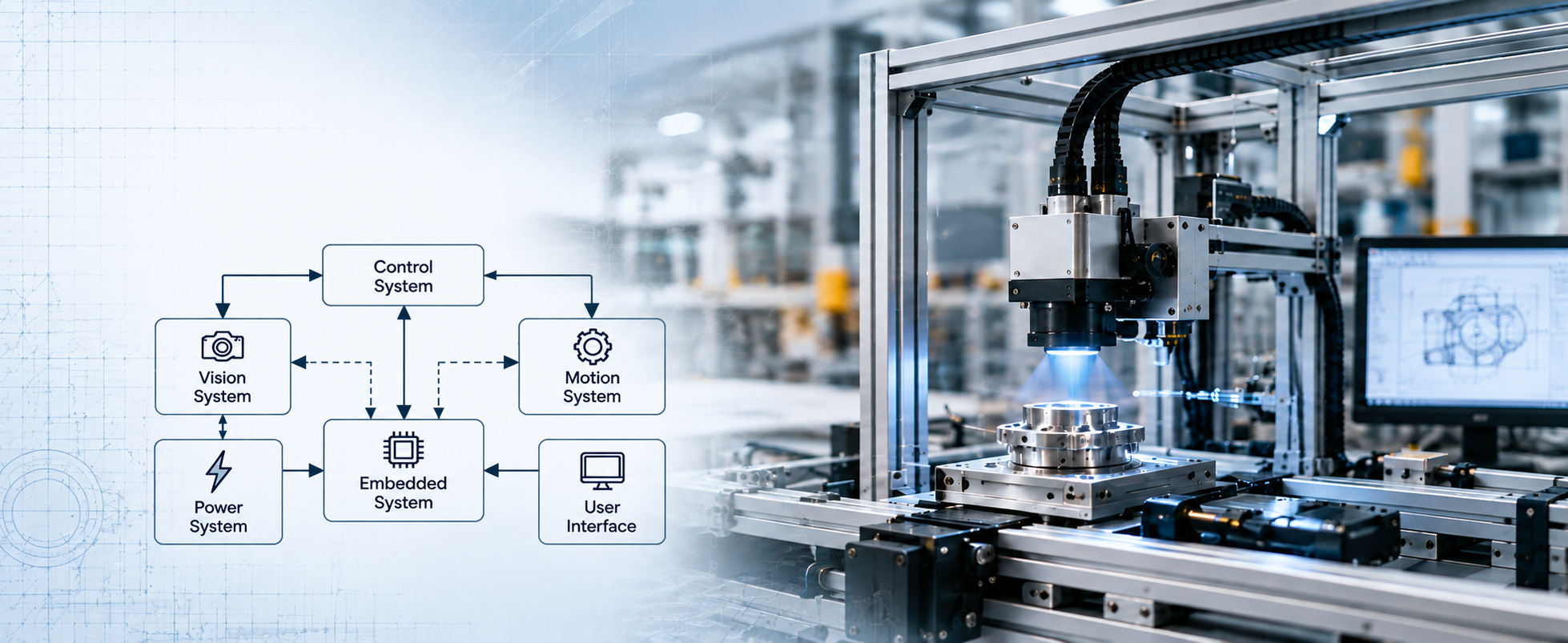

How system architecture defines the structure, interfaces, requirements, and technical decisions that allow complex engineering systems to work as a whole.
A complex engineering system can contain dozens or hundreds of individual components, each designed to perform a specific function. Yet a system can still fail even when every individual component works as intended.
The problem is often the relationship between those components.
A motor may provide the required torque, but the mechanism may not achieve the necessary accuracy. A processor may have sufficient computing capacity, but the system may not meet its thermal requirements. A sensor may provide the required accuracy, but its latency may interfere with the control system.
These are system-level problems.
System architecture provides the structure for addressing them. It establishes how the major elements of a system fit together, what functions they perform, how they interact, and what constraints govern those interactions.
For complex electromechanical products, system architecture creates the connection between requirements and detailed engineering across mechanical, electrical, embedded, controls, test, and manufacturing disciplines.
System architecture is the high-level structure of a system that defines its major elements, functions, relationships, interfaces, and constraints.
It answers a fundamental engineering question:
How should the system be structured so that its elements can work together to satisfy the system requirements? Architecture sits between the system need and detailed design.
At the beginning of a development program, engineers may understand what the product needs to accomplish without yet knowing exactly how it should be implemented. Architecture provides a framework for exploring those alternatives before detailed design decisions become difficult or expensive to change.
For example, an automated inspection system may need to position a component, capture an image, process inspection data, determine whether the component passes inspection, and communicate the result to a manufacturing system. Those requirements do not automatically define the architecture.
The engineering team still needs to determine how motion, sensing, lighting, computing, controls, mechanical structure, communications, and production interfaces should work together. That is the role of system architecture.
Systems engineering standards such as ISO/IEC/IEEE 15288 establish processes for managing systems across their lifecycle, from conception and development through production, utilization, support, and retirement. Architecture provides an important structure for making decisions throughout that lifecycle.
System architecture matters because decisions made at the system level influence almost every downstream engineering activity. A decision about where computing occurs can affect electrical power, thermal management, firmware, communications, packaging, and test.
A decision about how a mechanism is controlled can influence sensor selection, actuator selection, embedded software, mechanical tolerances, and verification. Without a system-level framework, individual engineering disciplines can optimize their own designs while unintentionally creating problems elsewhere.
The purpose of architecture is therefore not simply to document the system. It is to create a shared technical model that allows engineers to understand the consequences of their decisions.
For complex products, that shared understanding becomes particularly important as the number of interfaces and dependencies increases.
A system architecture normally connects three fundamental concepts: what the system must do, what elements perform those functions, and how those elements interact.
Functions describe what the system needs to accomplish. At this stage, engineers should avoid prematurely tying every function to a particular component. The objective is to understand system behavior before deciding exactly how that behavior will be implemented.
An automated inspection system, for example, may need to position a component, acquire an image, process inspection data, determine an outcome, and communicate that outcome.
The architecture then identifies the physical or logical elements responsible for those functions. Depending on the system, those elements might include mechanical assemblies, motors, sensors, controllers, embedded processors, software, power electronics, communication networks, or external systems.
Finally, the architecture defines how those elements interact. Interfaces can be mechanical, electrical, thermal, software-based, data-based, or related to control and timing. Interfaces are particularly important because they frequently represent the boundaries between engineering disciplines.
A mechanical interface might define mounting geometry and alignment. An electrical interface might define voltage, current, grounding, and power sequencing. A software interface might define communication protocols, data structures, timing, and error behavior.
A system architecture therefore needs to describe not only the components that exist, but also the relationships that allow them to operate as one system.
System architecture and system design are closely related, but they operate at different levels. Architecture establishes the system structure and major technical decisions. Design determines how those architectural decisions are implemented in detail.
The distinction becomes important when development teams begin detailed design too early.
For example, an engineer may select a high-performance processor because it satisfies the immediate computing requirement. But if that processor creates unacceptable thermal loads or power consumption, the decision affects mechanical packaging, electrical design, and potentially the entire system architecture.
Architecture provides the context in which those decisions can be evaluated.
Architecture should begin with the system need and requirements rather than with a list of components. A requirement such as “the system must inspect components automatically” is not enough to establish an architecture.
The engineering team needs to understand what inspection accuracy is required, how quickly inspection must occur, what environmental conditions exist, what data must be produced, how operators interact with the system, and what constraints apply to the manufacturing environment.
Those requirements can then be connected to system functions and elements.
A useful way to think about the relationship is:
Need → Requirements → Functions → Architecture → Detailed Design → Verification
The architecture provides the bridge between what the system needs to accomplish and how the engineering team intends to accomplish it. This relationship is also important for traceability. A requirement should ultimately have a place within the system architecture and a method for demonstrating that it has been satisfied.
System architecture becomes particularly important when a product combines physical and digital technologies.
Consider a robotic inspection platform.
The mechanical system positions the workpiece. Motion hardware moves the inspection head. Sensors provide position and system-state information. Lighting establishes the imaging conditions. A camera captures inspection data. Computing hardware processes that data. Controls coordinate movement and inspection. Software determines the inspection outcome. Manufacturing interfaces connect the equipment to the production environment.
None of these elements operates independently.
Increasing motion speed may reduce cycle time while increasing vibration. Increasing processor performance may improve image processing while increasing power consumption and thermal requirements. Changing the mechanical structure may alter sensor alignment and therefore affect inspection accuracy.
These interactions are architectural concerns.
A system architecture gives the engineering team a way to understand them before detailed subsystem decisions become difficult to change.
Embedded systems are often where physical and digital architectures meet.
An embedded architecture must establish what processing occurs where, how devices communicate, how signals move through the system, how timing is managed, and how the system responds to abnormal conditions.
For a precision motion system, for example, motor control, position feedback, trajectory planning, safety logic, and higher-level application software may all interact.
Those functions could potentially be centralized or distributed. That architectural decision affects hardware selection, firmware organization, communication protocols, synchronization, testability, and serviceability.
Embedded architecture should therefore be considered as part of the complete system rather than as an isolated software activity.
Architecture also influences how a system will eventually be verified. If a requirement cannot be connected to a system element or observable system behavior, demonstrating compliance can become difficult.
The same principle applies to interfaces. An interface requirement needs a corresponding method for verifying that the interface behaves as intended.
This creates a direct relationship between architecture and verification:
Requirements define what must be true. Architecture defines where those requirements are realized. Verification demonstrates that they have been satisfied.
Considering verification during architecture development can expose problems while there is still time to change the system structure. For complex products, this can be substantially more effective than discovering verification problems after detailed design is complete.
Architecture also influences whether a design can transition successfully from prototype to production. A prototype may tolerate manual assembly, difficult cable routing, specialized calibration, or labor-intensive inspection.
A production system may not. Manufacturing considerations can therefore influence architectural decisions before the first production unit is built. The way a product is partitioned can affect assembly, calibration, test access, supplier requirements, serviceability, and production testing.
This is especially important when a product is expected to move from a small number of engineering builds to repeatable production. A technically functional architecture is not necessarily a production-ready architecture.
Three problems appear repeatedly in complex system development.
Choosing processors, motors, sensors, or other components before understanding the system requirements can constrain the architecture prematurely. The resulting system may work, but it may not provide the required performance, reliability, manufacturability, or scalability.
A subsystem can satisfy its own specifications while creating problems at the system level. Mechanical, electrical, firmware, controls, test, and manufacturing decisions need to be evaluated within the context of the complete system.
Architecture should evolve as engineers learn more about the system. Testing, prototyping, manufacturing analysis, technology constraints, and changing requirements can all expose information that requires an architectural decision to be revisited.
Systems engineering standards recognize this iterative nature of system development rather than treating engineering as a strictly linear process.
System architecture should be developed early enough to influence major technical decisions. That does not mean every architectural detail must be finalized before engineering begins. In complex development programs, architecture and prototyping often inform one another.
A feasibility prototype may reveal that a sensor does not perform adequately in the operating environment. A thermal experiment may invalidate an assumed packaging approach. A manufacturing review may expose assembly complexity that changes the preferred subsystem boundaries.
The architecture can then evolve. The objective is not to eliminate uncertainty before development starts. It is to resolve the highest-impact uncertainty while the engineering team still has meaningful options.
Good architecture is not necessarily the most sophisticated architecture. It is an architecture that establishes a coherent relationship between requirements, functions, system elements, interfaces, constraints, and verification. It should also be understandable across disciplines.
A mechanical engineer should understand the mechanical boundaries. An electrical engineer should understand power and signal interfaces. A firmware engineer should understand control and communication responsibilities. A test engineer should understand how system behavior will be demonstrated.
Most importantly, everyone should understand how their decisions affect the complete system. That is the practical value of systems thinking.
System architecture is the high-level organization of an engineered system. It defines major system elements, their functions, relationships, interfaces, and important constraints.
Architecture establishes the system-level structure and major technical decisions. System design develops the detailed implementation of those decisions.
System architecture provides a framework for coordinating technical decisions across the system. It helps engineers understand interfaces, allocate requirements, evaluate alternatives, and connect system-level decisions to detailed engineering and verification.
No. System architecture applies to physical, digital, electromechanical, and integrated systems. It is particularly important when mechanical, electrical, embedded, controls, test, and manufacturing disciplines must work together.
Complex engineering systems rarely become difficult because of one isolated technical problem. They become difficult when many technically reasonable decisions interact in ways that were not understood early enough.
System architecture provides a framework for managing those interactions. By defining requirements, functions, system elements, interfaces, and constraints before detailed implementation is locked in, engineering teams can make better-informed decisions about how the complete system should work.
For complex electromechanical products, architecture is therefore more than a system diagram.
It is the technical structure that connects disciplines and provides a path from requirements to a system that can perform, be verified, manufactured, and supported.