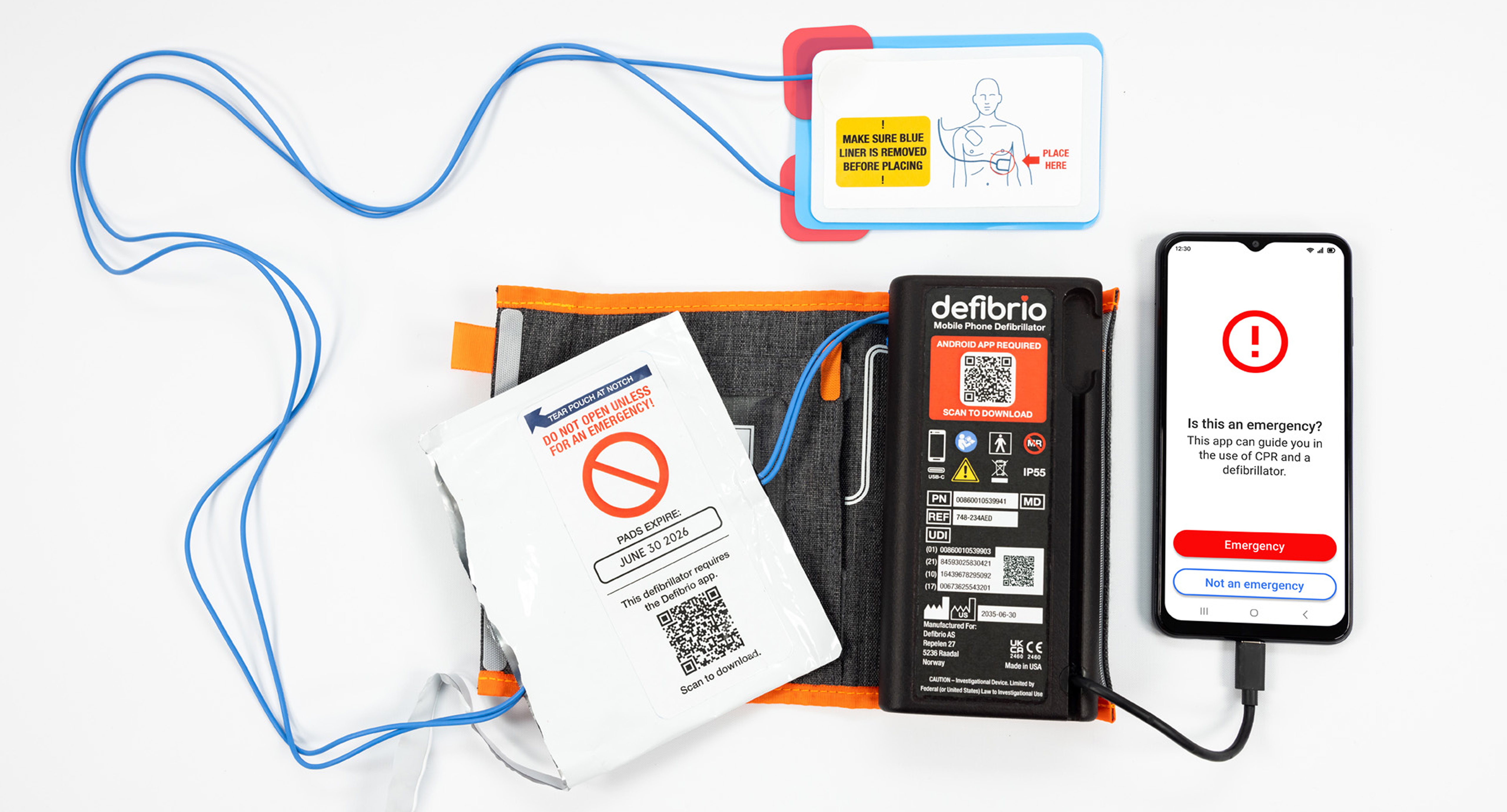

We partnered with Defibrio to engineer the first AED (Automated External Defibrillator) powered by a smartphone. Sudden cardiac arrest calls for a defibrillating shock administered within three to five minutes, but a traditional AED is rarely on hand when it happens. Defibrio set out to close that gap by building a real defibrillator small enough to carry, affordable enough to own, and simple enough for an untrained bystander to use.
Working across electrical, embedded software, mechanical, and test and validation engineering, we built and proved the systems at the core of Defibrio's AED.
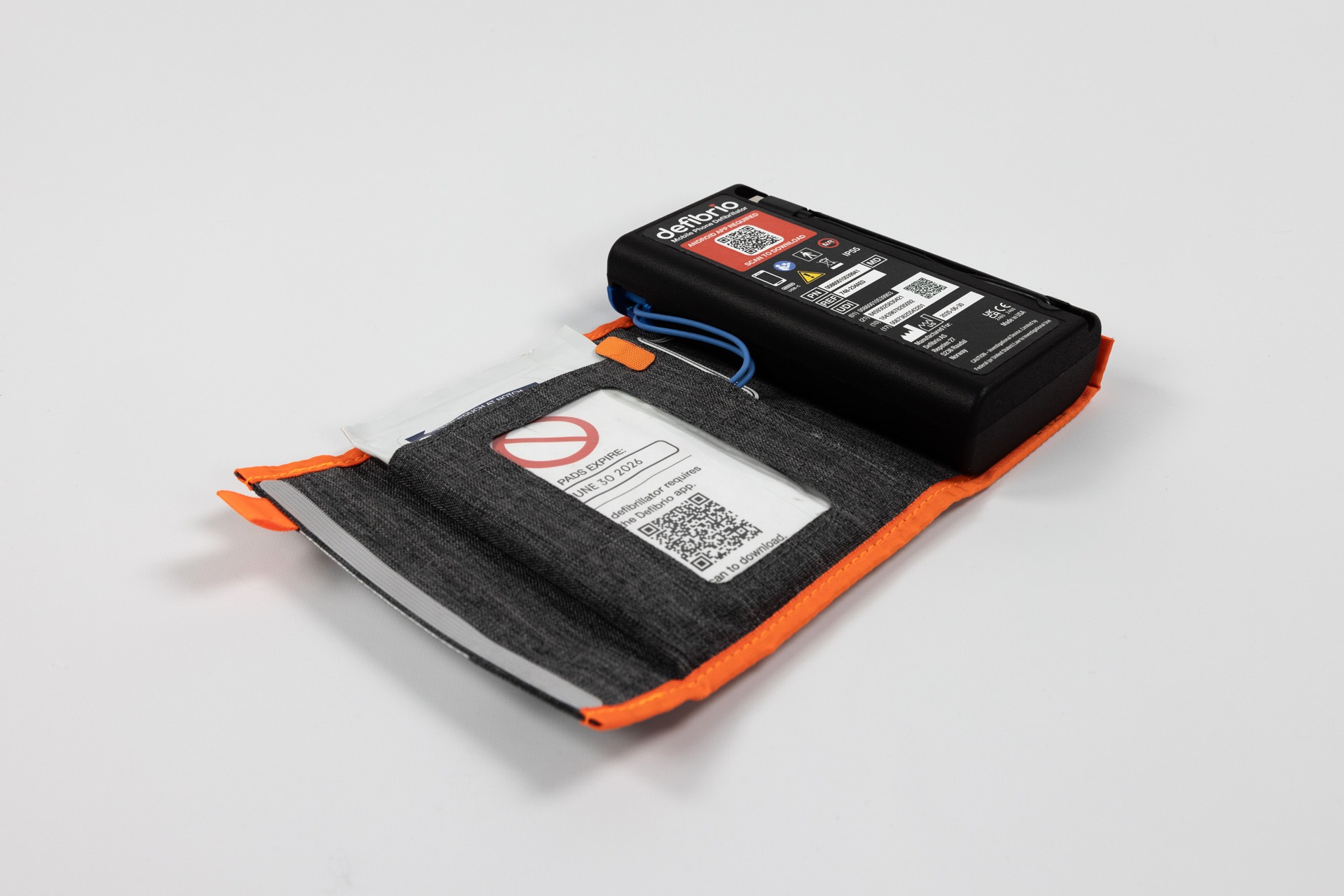
A defibrillation shock needs far more voltage than a phone battery delivers, and the device had no room for the bulky capacitors a conventional AED relies on. We customized the power-conversion topology to step up the battery's low-voltage output into the high-voltage biphasic shock a defibrillator delivers. Early failure analysis and iterative simulation refined it, balancing energy density, durability, and size. Along the way we evaluated capacitor technologies for charge retention and discharge speed, hand-wound transformers to validate volumetric fit, thermal management, and energy transfer, and ran rapid bench testing so each prototype refined the energy delivery of the next.

Monica Shah
Senior Project Manager & MedTech Specialist, Andrews Cooper
Conventional AEDs carry dedicated rhythm-recognition hardware. Defibrio had to make that call in real time on a phone, fast and accurate enough to satisfy a regulator. We built a clinical review tool so cardiologists could classify thousands of ECG recordings, trained a custom algorithm on that data, and tested against industry benchmarks for the sensitivity and specificity the regulatory pathway required.
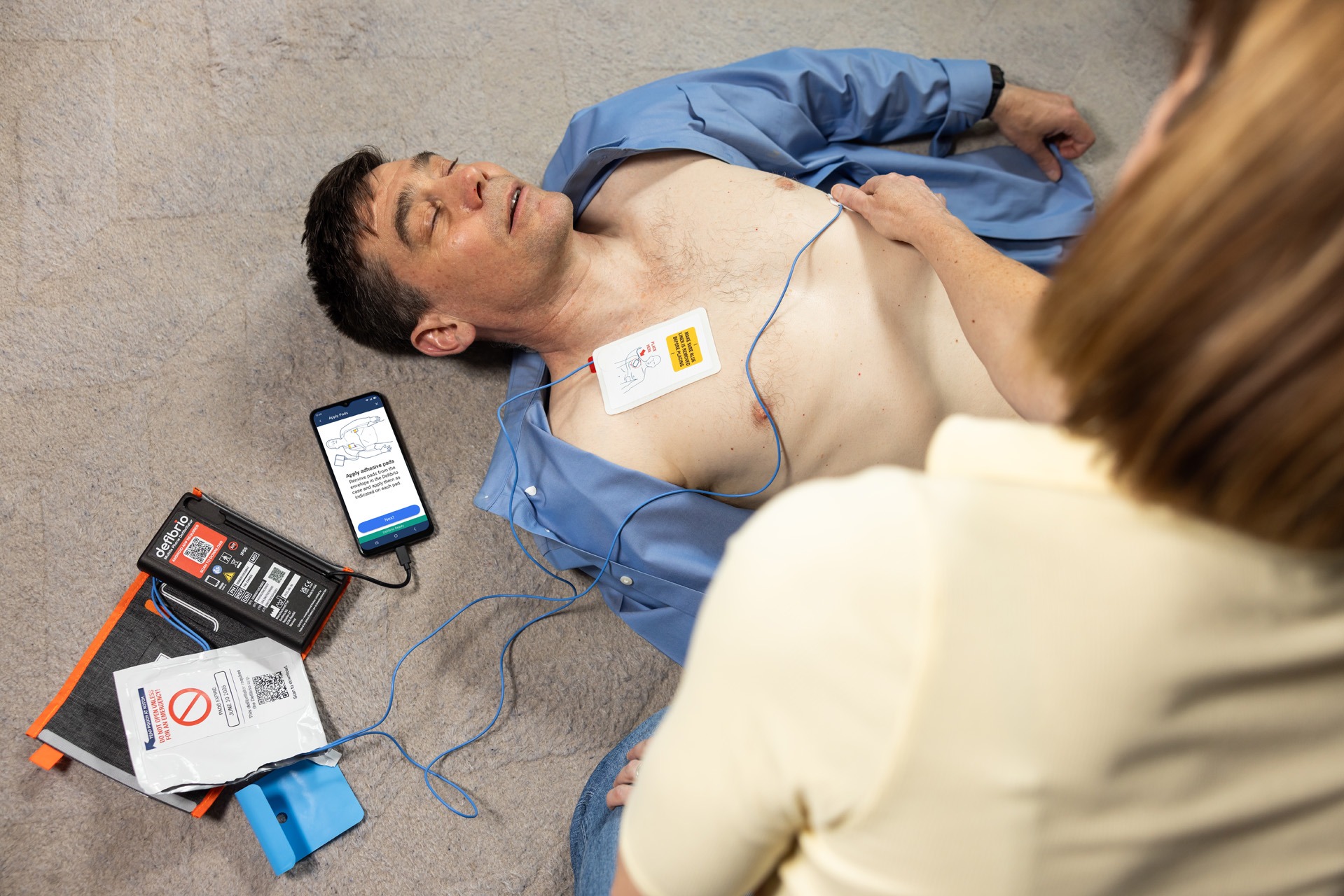
None of it counted until the device could survive a glovebox. We ran a test lab integrated with the development team, cycling the AED through temperature stress, drop-shock and vibration with high-speed imaging, IP55 water resistance, and electromagnetic compatibility testing. Early units went to a Massachusetts General clinical symposium, where clinicians confirmed the proof of concept against real emergency-care protocols.
Because the AED is a Class III medical device, compliance shaped the engineering from the start. Our test engineers developed and executed hundreds of protocols against FDA Class III and EU MDR requirements: risk assessment and hazard analysis that drove design refinements, IEC 60601 validation of electrical safety and energy-transfer consistency, and the documentation a regulatory submission depends on.
Sudden cardiac arrest gives no warning and little time, but a defibrillator small enough to carry is one that has a chance to be there when it matters. Today, Defibrio's AED brings together the systems we helped engineer: a therapeutic shock drawn from a phone battery, rhythm recognition that runs in software, and hardware built to survive the real world. On August 25, 2026, the device earned IDE approval, clearing it to begin human clinical studies. We are proud to have helped bring this idea to life—and even more excited about its potential to put life-saving intervention within reach when every second counts.
Mechanical Engineering
• Enclosures, structures, and thermal systems
• Ruggedization for shock, vibration, ingress, and environment
Electrical Engineering
• Power systems and power management
• System-level electrical architecture
Embedded Systems & Firmware
• Embedded and real-time systems
• Control algorithms and device communication
Systems Engineering & Controls
• Trade studies and feasibility analysis
• Risk identification and mitigation planning
• Integration planning across mechanical, electrical, and software domains
Test, Validation & Reliability
• Verification and validation (V&V) planning and execution
• Custom test fixtures, life testers, and test automation
• Environmental and life testing
• Failure analysis and design feedback